
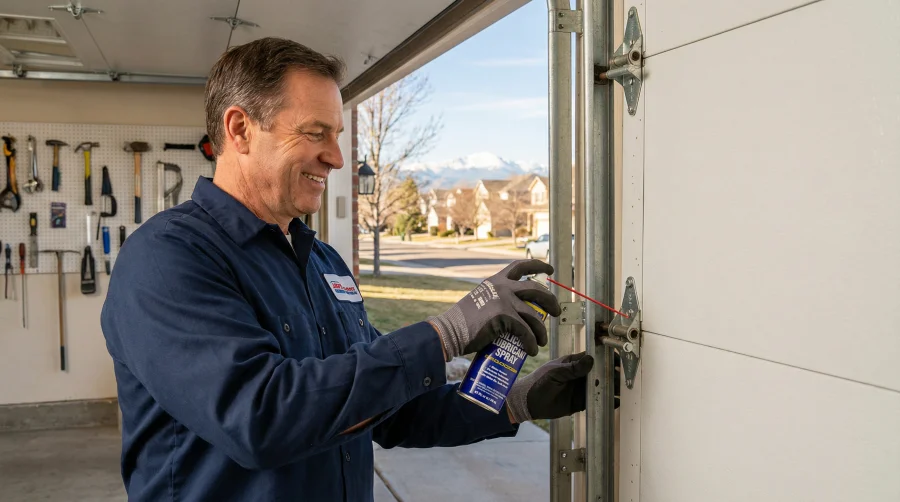
Garage Door Lubrication: A Homeowner’s Guide to a Quieter, Longer-Lasting Door
A garage door is the largest moving object in most homes—and one of the most used. When it’s running smoothly, you barely notice it. When it’s dry, noisy, or jerky, it can become a daily frustration and (more importantly) a safety concern for your family.
Quick take: Lubrication reduces friction on key moving parts, which helps your garage door operate more quietly, more reliably, and with less wear. Done correctly a couple of times a year, it’s one of the easiest ways to keep your garage door safe and dependable for your family, while avoiding premature part replacement and extending the life of your opener.
Why lubrication matters (beyond the squeaking)
Garage doors have multiple metal-on-metal contact points: hinges pivot, rollers spin, springs flex under heavy tension, and bearings rotate. Over time, those parts can dry out. This is especially true here in Colorado, where our dry air, low humidity, and freeze-thaw cycles accelerate the drying out of garage door hardware. This leads to:
•More noise: squeaks, grinding, rattling, and popping
•More strain on the opener: the motor works harder when friction increases
•Faster wear on parts: rollers, hinges, bearings, and springs can degrade sooner
•Inconsistent operation: jerky movement, shuddering, or uneven travel
•Higher risk of failure at the worst time: like when you’re late for work or it’s freezing outside
From a “peace of mind” perspective, lubrication is a crucial part of preventative maintenance that helps keep your garage door dependable—so it’s doing its job of protecting your home, not adding stress. It’s a proactive habit that prevents small issues from turning into costly emergency repairs.
What lubrication actually does (simple + detailed)
Simple explanation: Lubricant creates a thin, protective film that helps parts move without grinding.
More detailed explanation: Most garage door noise and wear comes from friction + vibration. When hinges, rollers, and springs move under load without proper lubrication, microscopic abrasion increases. That abrasion creates heat, noise, and metal dust, which accelerates wear. A proper garage-door lubricant reduces friction, helps dampen vibration, and can also offer some protection against moisture and corrosion—especially important for exposed hardware.
(For more in-depth information on how all these parts work together, check out our Ultimate Guide to Garage Doors.)
The biggest misconception: “Any spray will do”
One of the most common DIY mistakes is grabbing a general-purpose product and spraying everything in sight.
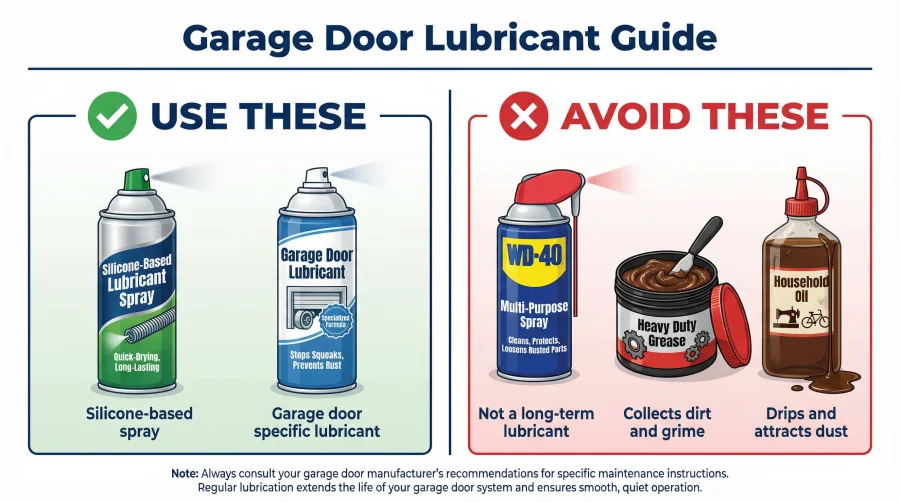
Here’s the safe rule of thumb:
•Use: a garage-door-specific lubricant or a silicone-based lubricant designed for hardware
•Avoid: WD-40 as your primary lubricant (it’s great as a cleaner/water displacer, but it’s not a long-lasting garage door lube)
•Avoid: heavy grease that collects dirt, and oils that drip everywhere
If you’re not sure what you have in the garage, it’s better to pause than to coat your door in something that attracts grime and turns into a sticky mess.
What parts should you lubricate?
Focus on the components that pivot, rotate, or flex.
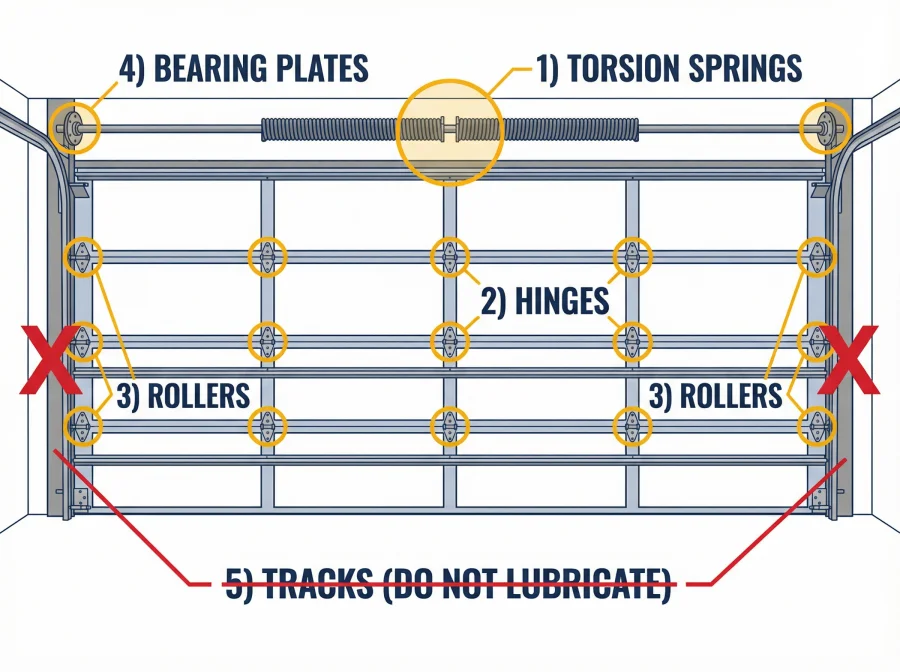
1) Rollers (the wheels that ride in the track)
•Lubricate the roller bearings (the small inner moving parts), not the entire wheel surface.
•If your rollers are nylon with sealed bearings, they may need little to no lubrication—depending on the style.
2) Hinges
•A small amount at the pivot points helps reduce squeaks and vibration.
3) Springs (torsion or extension)
•Springs do a huge amount of work and can be a major source of noise.
•A light, even application helps reduce “twang” and wear.
4) Bearings and bearing plates
•These support rotating shafts (common on torsion systems) and benefit from proper lubrication.
5) The opener rail (sometimes)
•Some opener rails/chains/screws have manufacturer-specific guidance. Check your opener manual.
•When in doubt, lubricate the door hardware first; opener-specific lubrication depends on model.
What not to lubricate
The tracks
This surprises many homeowners: garage door tracks generally should not be lubricated.
Lubricating tracks can cause:
•dirt buildup
•sticky residue
•rollers slipping instead of rolling cleanly
Instead, clean the tracks with a dry cloth (or a mild cleaner if needed), then leave them dry.
How often should you lubricate your garage door?
For most homeowners, a good cadence is:
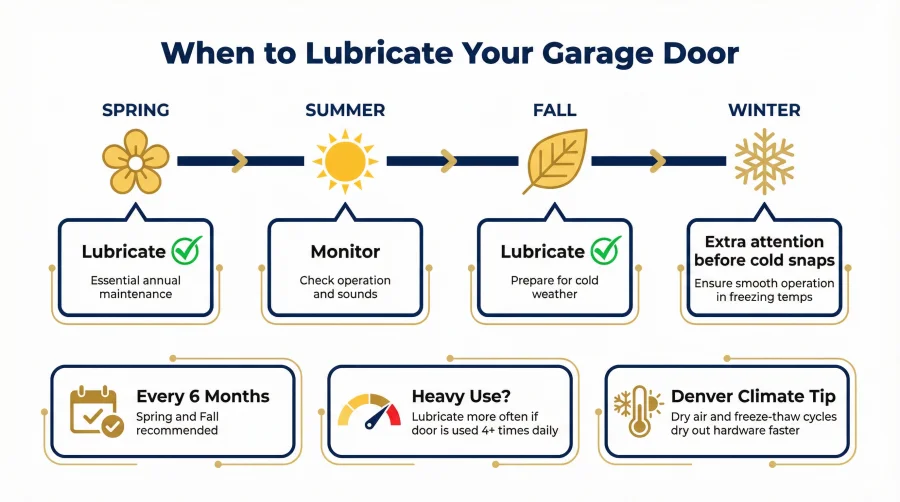
•Every 6 months (spring and fall)
•More often if the door gets heavy daily use, sounds noisy quickly, or you notice vibration
•Before winter is especially helpful in the Denver metro area, where temperature swings from the 60s to below zero can put extra stress on moving parts. (See our guide on How to Prepare Your Garage Door for a Colorado Winter for more tips.)
A door that runs smoothly isn’t just nicer—it often signals that the system is experiencing less stress overall.
A safe, homeowner-friendly lubrication checklist
If you’re comfortable doing light maintenance, here’s a straightforward approach. Keep it calm, careful, and minimal—more lubricant is not better.
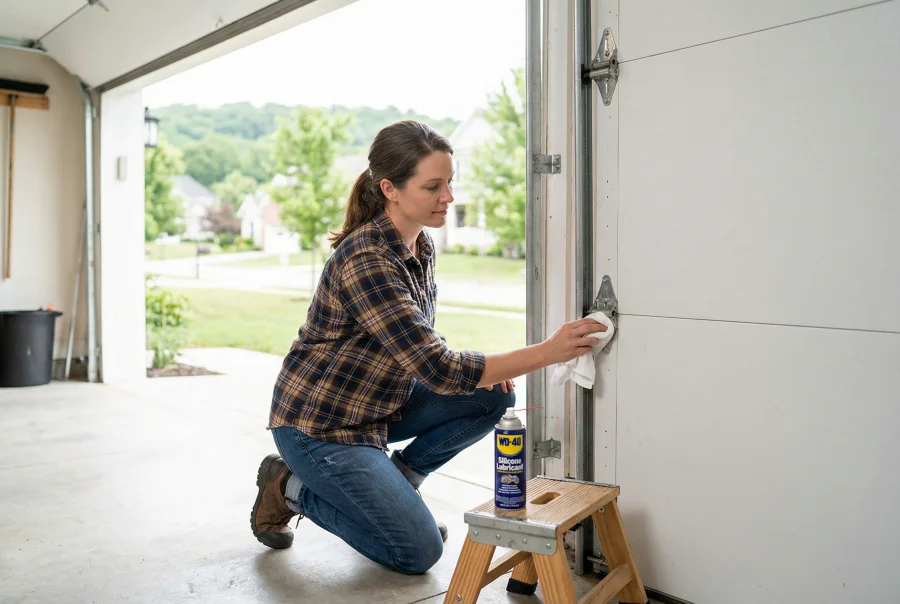
1.Close the garage door fully.
2.Turn off the opener (unplug it or switch it off) so it can’t activate unexpectedly.
3.Clean first: wipe dust and grime off hinges/rollers/springs with a rag.
4.Apply lubricant sparingly to:
•hinge pivot points
•roller bearings
•springs (light, even coat)
•bearings/bearing plates (if accessible)
5.Open and close the door manually a couple of times (if you can do so safely) to distribute lubricant.
6.Wipe any drips to keep dirt from sticking.
7.Restore power and test the opener.
Important safety note: Springs are under significant tension. You can lubricate them, but do not adjust, loosen, or tamper with springs or cables. If anything looks frayed, loose, or unusually worn, it’s time to call a professional.
Signs your door needs lubrication (or a tune-up)
Lubrication helps, but it won’t “fix” deeper mechanical issues. If you notice any of the following, it may be time for a full inspection:
•Loud squealing or grinding that returns quickly after lubrication
•Door shudders, jerks, or looks uneven while moving
•Rollers wobble in the track or appear chipped or cracked
•Door feels heavy to lift manually
•Door reverses unexpectedly or doesn’t close cleanly
•Visible rust, worn hinges, or fraying cables
In these cases, lubrication is a helpful first step—but the safest next step is a professional tune-up to prevent a small issue from becoming a breakdown.
Why this matters for your family’s safety
A garage door system is a balance of heavy weight and controlled motion. When parts wear prematurely, the door can become unpredictable—louder, rougher, and more prone to failure. Routine lubrication supports:
•smoother operation (less jolting and vibration)
•more consistent safety performance (especially when paired with sensor checks)
•reliable access and security (your door closes properly and stays secure)
If your garage is a primary entry point for your household, this is one of those “small habits” that pays off in comfort and confidence.
When it’s better to call a pro
If you want to keep your garage door running like it should—but don’t want to risk working near high-tension components—professional maintenance is often the best choice, especially when:
•you suspect spring, cable, or track alignment issues
•the door is unusually loud even after lubrication
•the door is heavy, uneven, or hard to lift
•you want a full garage door safety inspection and tune-up
With over 55 years of combined experience, our family-owned team has seen every type of garage door issue Colorado homeowners face. If you’re in the Metro Denver area and would like a trusted, straightforward assessment, Metro Denver Garage Door can help you get back to smooth, quiet operation—without pressure or upsells.
Learn more or schedule service at metrodenvergaragedoor.com.
Summary (key takeaways)
•Lubricating your garage door reduces friction, which lowers noise, wear, and strain on your opener.
•Lubricate hinges, roller bearings, springs, and bearings—but don’t lubricate the tracks.
•Use a garage-door-specific or silicone-based lubricant, and avoid treating WD-40 as the long-term solution.
•A simple twice-a-year routine can extend the life of your system and improve day-to-day reliability.
•If anything looks worn, uneven, or unsafe, skip the DIY adjustment and schedule a professional tune-up.
